



Pu-erh is not brewed the way ordinary black or green tea is. You don't "steep" it for 5 minutes in a cup — you flush it, many times for 5–20 seconds with hot water at 95–100 °C. Let's go step by step: how much leaf to take, what water and temperature to use, how shou differs from sheng and which mistakes kill the taste.
How brewing pu-erh differs from ordinary tea
Pu-erh is a post-fermented tea made from the large leaf of the Camellia sinensis (var. assamica) variety. Unlike green tea, it easily withstands boiling water and opens up over 6–10 short infusions. The same leaf gives flavour 8–12 times — that's a normal brew, not a 'spent' tea. The leaf is dense, pressed into a cake (bing), tuo or tablet, so for the first few seconds it merely soaks, and the flavour comes through from the second or third infusion.
Water, temperature and amount of leaf
The basic ratio is 5–7 g of leaf per 100 ml of water. That's 2–3 times more than for black tea, because the contact time is short. Use soft, bottled water with a mineralisation of 50–150 mg/l; hard tap water gives a flat taste and a film on the surface.
| Parameter | Shou (ripe) | Sheng (green/raw) |
|---|---|---|
| Water temperature | 98–100 °C | 90–95 °C |
| Leaf per 100 ml | 6–7 g | 5–6 g |
| Rinse | 1–2 times, 5–10 sec | 1 time, 5 sec |
| First infusion | 0.3–0.5 mg | 7 sec |
| Number of infusions | 8–12 | 6–10 |
Young sheng (up to 3 years) turns bitter when overheated — for it we keep 90 °C. Aged shou forgives boiling water and even requires it for depth of flavor.
How to brew pu-erh by infusion: step by step
The classic method is gongfu cha in a gaiwan or a small 100–150 ml teapot. Pu-erh doesn't like a 400 ml cup with long steeping: it over-extracts and turns bitter.
Step 1. Rinse (awakening the leaf)
Pour boiling water over the leaf and drain it immediately after 5–10 seconds. This water isn't drunk — it rinses off the pressing dust and 'wakes' the leaf. For a densely pressed cake the rinse is done twice.
Step 2. Short infusions
Pour the water in and drain it completely, leaving no liquid on the leaf. The first 3 infusions — 7–10 seconds each. After that add 5–10 seconds to each: the leaf gives less, and time compensates. Drain to the last drop, otherwise the next infusion turns bitter.
Pressed and loose pu-erh — what's the difference
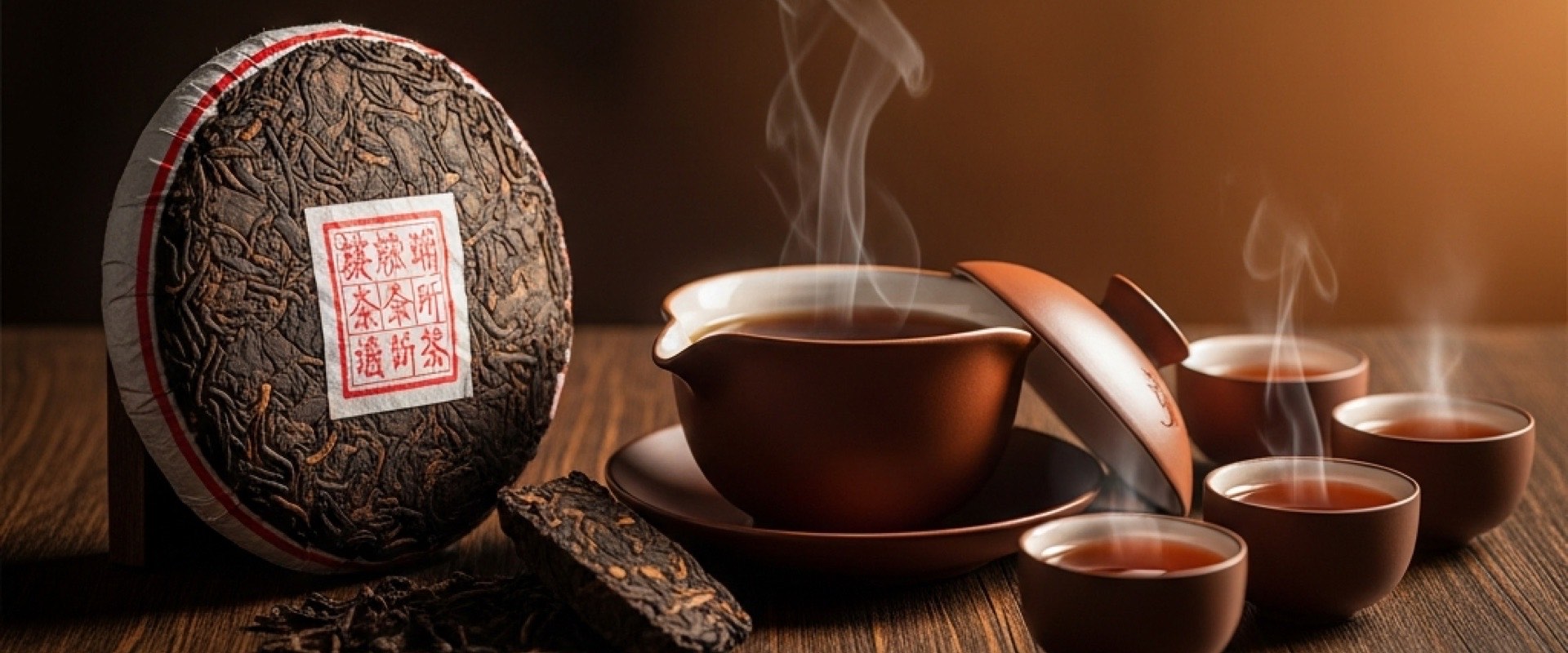
Compressed tea (a 357 g cake, tuocha, tablet) stores longer and matures over years — it's a format for aging. Loose-leaf is handier day to day: no need to pry off a portion with a knife. With equal raw material there's almost no difference in taste, only in convenience. From a cake you pry off 6–7 g with a special pick along the layers rather than breaking off a chunk crosswise — this way the leaf breaks less and the infusion comes out more even.
Common mistakes when brewing pu-erh
The main one is over-steeping like a tea bag. Three minutes on the leaf turns even a good shou into bitter blackness. The second is cold water: at 80 °C pu-erh doesn't open up and the taste is flat. The third is skimping on leaf: 2 g per pot gives you «water», pu-erh needs a dense load. The fourth is storing it next to spices and coffee: pu-erh absorbs odours, so keep it separately in paper or cardboard, without airtight plastic.
If you want to start with a mild flavour — go for ready shou pu-erh from our catalog: it's earthy, without bitterness and forgives a beginner's mistakes. And our breakdown will help you get to grips with the tea opposite in character the benefits and harms of green tea.
How to store pu-erh
Pu-erh is the only tea that gets better with age when stored properly. Keep it at 20–25 °C and 60–70 % humidity, away from direct sunlight and strong odors. Don't seal it in airtight plastic: the leaf needs air to mature slowly. Store a cake in its original paper or a cardboard box, and loose leaf in ceramic or dense cardboard. Keep coffee, spices, and household chemicals away — pu-erh absorbs odors within a couple of days. Shou keeps almost indefinitely, while sheng reveals itself more fully after 5–10 years of aging under these conditions.
Which pu-erh should a beginner choose
Start with shou pu-erh in tuo cha or mini-tablet form of 5–7 g — that's a single serving, no need to chip anything off with a knife. Shou is soft, earthy, free of bitterness and forgives mistakes in temperature and timing. Move on to young sheng later, once you're used to short infusions: it's brighter and more interesting but needs a precise 90 °C, otherwise it turns bitter. The price gap is noticeable — an inexpensive factory shou fully reveals the brewing technique, so there's no point overpaying for aged cakes at the start.
А про то, помогает ли пуэр сбросить вес и как его пить в этом случае — в статье pu-erh for weight loss.
Frequently asked questions
How many times can pu-erh be brewed?
A quality pu-erh withstands 8–12 infusions of 5–20 seconds. The taste changes from infusion to infusion: the peak is usually at the 3rd–5th. When the liquor turns pale and empty, the leaf is spent.
What water should pu-erh be brewed with?
Shou — with 98–100 °C boiling water, sheng — 90–95 °C. The water should be soft, with mineralization of 50–150 mg/l. Hard tap water gives a flat taste and a film, so it's better not to use it.
Do you need to rinse pu-erh before brewing?
Yes. The first 5–10 second infusion is drained off — it rinses away the pressing dust and awakens the leaf. This water isn't drunk. A dense cake is rinsed twice.
How does shou differ from sheng pu-erh?
Shou is artificially fermented, dark, earthy, mild, ready to drink right away. Sheng is raw, lighter, with bitterness and fruity acidity, maturing over years. Beginners find it easier to start with shou. We compared both types in detail in a separate article — shou and sheng pu-erh: what's the difference and which to choose.
Can pu-erh be brewed in a thermos?
You can, but it's a different taste — strong and dense, without a play of nuances. Take 4–5 g per 0.5 l, pour boiling water, and drink after 10–15 minutes. Don't keep it longer — it will turn bitter.
Why does pu-erh turn bitter?
Three reasons: too long an infusion, overheated water for a young sheng, or an incomplete pour-off between infusions. Cut the time to 7–10 seconds and drain the infusion to the last drop.
AMIR TEA — natural tea from Samarkand. We select pu-erh, green and black tea and advise on brewing. Catalog and orders — at amirtea.uz.
Details on the drink's properties, daily amount and contraindications — in the article pu-erh: benefits and harm.