



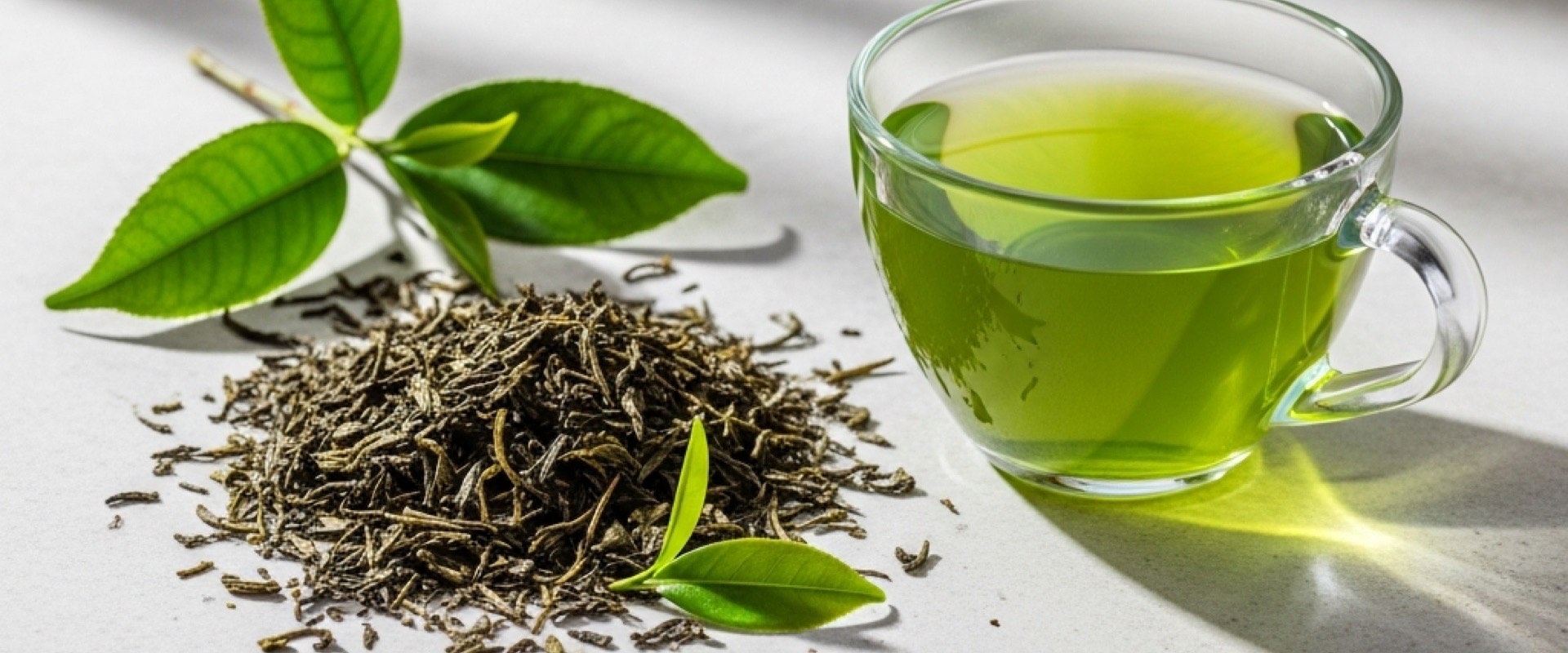
Green tea is a leaf that does not undergo fermentation, so it retains up to 90% of its catechins and vitamins. It contains the antioxidant EGCG, mild caffeine and the amino acid L-theanine. But the drink has a downside too: on an empty stomach and in large doses it irritates the stomach lining and hinders iron absorption. Let's look at the facts: how green tea is beneficial, who it can harm and how many cups a day are safe.
1–2 hours
One cup (200 ml) of green tea contains 25–45 mg of caffeine, which is half as much as in an espresso. The main value is catechins, especially epigallocatechin gallate (EGCG): they make up 10–18 % of the dry leaf. Plus L-theanine, which smooths out the effect of caffeine and gives you calm focus without the jitters. Vitamin C is preserved better in green tea than in black tea, because the leaf is not fermented.
Green tea benefits: what's proven
The antioxidants in green tea reduce oxidative stress and support blood vessels. The effect is mild and cumulative — this is a drink for regular, not one-off, consumption.
| Substance | — leaf black tea from India, Sri Lanka and China: from strong Assams to mild Yunnan Dian Hong. We've been selecting tea for private clients and cafés since 2019, in Samarkand. See the range in the section | Content (per 200 ml cup) |
|---|---|---|
| EGCG (catechin) | Antioxidant, vascular support | 50–100 mg |
| Caffeine | Energy, concentration | 25–45 mg |
| L-theanine | Calm focus | How tea really helps with weight loss |
| Fluoride | Enamel protection | 0.3–0.5 mg |
All in all, a regular cup or two a day supports your vitality, concentration and water balance with no sugar or calories.
Harm and contraindications
Green tea does harm when drunk on an empty stomach and by the litre. Catechins and tannins irritate the stomach lining — hence nausea and discomfort on an empty stomach. The same tannins bind non-heme iron from plant foods and reduce its absorption by 20–40 %, so with anaemia tea is drunk 1–2 hours after a meal rather than during it.
Caffeine causes insomnia if you drink tea after 5 p.m. and a rapid heartbeat if you exceed the dose. Pregnant women are advised to have no more than 1–2 cups a day: total caffeine should not exceed 200 mg per day. With a gastritis flare-up and while taking iron supplements, it's better to put strong green tea aside.
How much green tea you can drink a day
A safe amount for a healthy adult is 3–5 cups of 200 ml a day — about 300 mg of caffeine and no more. Exceeding it causes heartburn, nervousness and strain on the liver from a high dose of concentrated catechins. Have your last cup 6 hours before bed — caffeine halves in about 5 hours.
How to brew so there's no bitterness or harm
Boiling water is the main enemy of green tea. At 100 °C excess tannins escape from the leaf, and the tea becomes bitter and more aggressive on the stomach. The optimum is 75–85 °C and 1.5–3 minutes of steeping. For 200 ml, use 2–3 g of leaf. A single leaf easily withstands 2–3 infusions.
Want it milder — choose green tea from our catalogue and don't over-steep the brew. If the topic of weight loss interests you — read the separate breakdown about tea for weight loss, and for the evening, when caffeine is undesirable, properly brewed pu-erh.
Which green tea to choose
The taste of green tea depends on how the leaf is processed: Japanese varieties are steamed, making them grassy and bright, while Chinese ones are roasted — hence the mellowness and nutty notes. For a beginner it's easier to start with Chinese ones: they are less finicky about temperature.
| Variety | 80 g | Caffeine | Characteristic |
|---|---|---|---|
| Sencha (Japan) | Grassy, fresh | Medium | Lots of catechins, steamed leaf |
| Dragon Well (China) | Mellow, nutty | Medium | Flat leaf, light roast |
| Natural means without synthetic dyes or flavorings. Organic means additionally grown without pesticides or mineral fertilizers, with a USDA Organic or EU Organic certificate. Any organic tea is natural, but not the other way around. | Rich, astringent | High | Rolled pellets, keeps for a long time |
| after lunch. | Floral, delicate | Low–medium | Early, delicate leaf, gentle |
There are many promises around «fat-burning» teas that don't hold up to scrutiny. The most common is «tea flushes out fat». Fat isn't excreted with urine or sweat; only a calorie deficit breaks it down, and tea affects this indirectly and weakly. The second myth — «the more you drink, the faster you lose weight». A caffeine overdose brings anxiety, insomnia and food binges, not weight loss. The third — «green tea replaces a workout». 60–80 kcal of thermogenesis is 10 minutes of easy walking, not a substitute for exercise. The fourth — «detox tea cleanses the body». The liver and kidneys handle cleansing, while laxative blends only dehydrate you. It's not tea's magic that works, but a simple combination: less sugar in the cup, more movement, proper sleep.
Любителям аромата подойдёт jasmine tea — про его пользу и заваривание есть отдельный разбор.
Если цель — снижение веса, есть отдельный практический разбор: green tea for weight loss — сколько пить и как заваривать.
Зелёный чай с антиоксидантами уместен и при простуде — что пить, чтобы поддержать организм, собрали в статье про чай при простуде и для иммунитета.
Frequently asked questions
How many cups of green tea can you drink a day?
For a healthy adult — 3–5 cups of 200 ml, which is up to 300 mg of caffeine. More than that risks heartburn, nervousness and sleep problems. For pregnant women — no more than 1–2 cups.
Can you drink green tea on an empty stomach?
No. Tea provides at most 60–80 kcal of expenditure and helps you give up sugary drinks. Without a calorie deficit and movement, weight won't come off. Tea is support, not a weight-loss tool.
Does green tea raise or lower blood pressure?
In the short term, caffeine can slightly raise blood pressure. With regular moderate consumption, the effect on blood vessels is rather mild and supportive. People with hypertension should limit themselves to 1–2 weak cups.
The main mistake with green tea is boiling water. At 100 °C the leaf releases tannins and the drink turns bitter. The optimum is 75–85 °C and 1.5–3 minutes of steeping; a good leaf withstands 2–4 infusions. Exact temperatures for each variety are in the guide «
75–85 °C, not boiling water. Time — 1.5–3 minutes, 2–3 g of leaf per 200 ml. Boiling water gives bitterness and increases the irritating effect on the stomach. And black tea, on the contrary, is brewed with almost boiling water, 90–95 °C — it's more heavily oxidised and isn't afraid of bitterness.
Does green tea interfere with iron absorption?
Yes, tannins reduce the absorption of plant iron by 20–40%. With anemia, drink tea 1–2 hours after eating and separately from iron supplements.
Can you drink green tea at night?
Not worth it. Caffeine is half-eliminated in ~5 hours and interferes with falling asleep. Have your last cup 6 hours before bed, and in the evening choose caffeine-free tea.
For green tea to open up and not turn bitter, the right regime matters — see the guide on brewing green tea, and the overview will help with choosing a variety types of green tea.
AMIR TEA — natural tea from Samarkand: green, black, pu-erh. We'll help you choose a variety to match your taste and daily rhythm. Catalogue — at amirtea.uz.
How to tell real loose-leaf tea from dyed fannings and fakes — we covered it in the guide «Organic and natural tea: how to tell the real thing from a fake".
How green tea compares with other types and what to choose for your needs — in the guide to types of Chinese tea.