



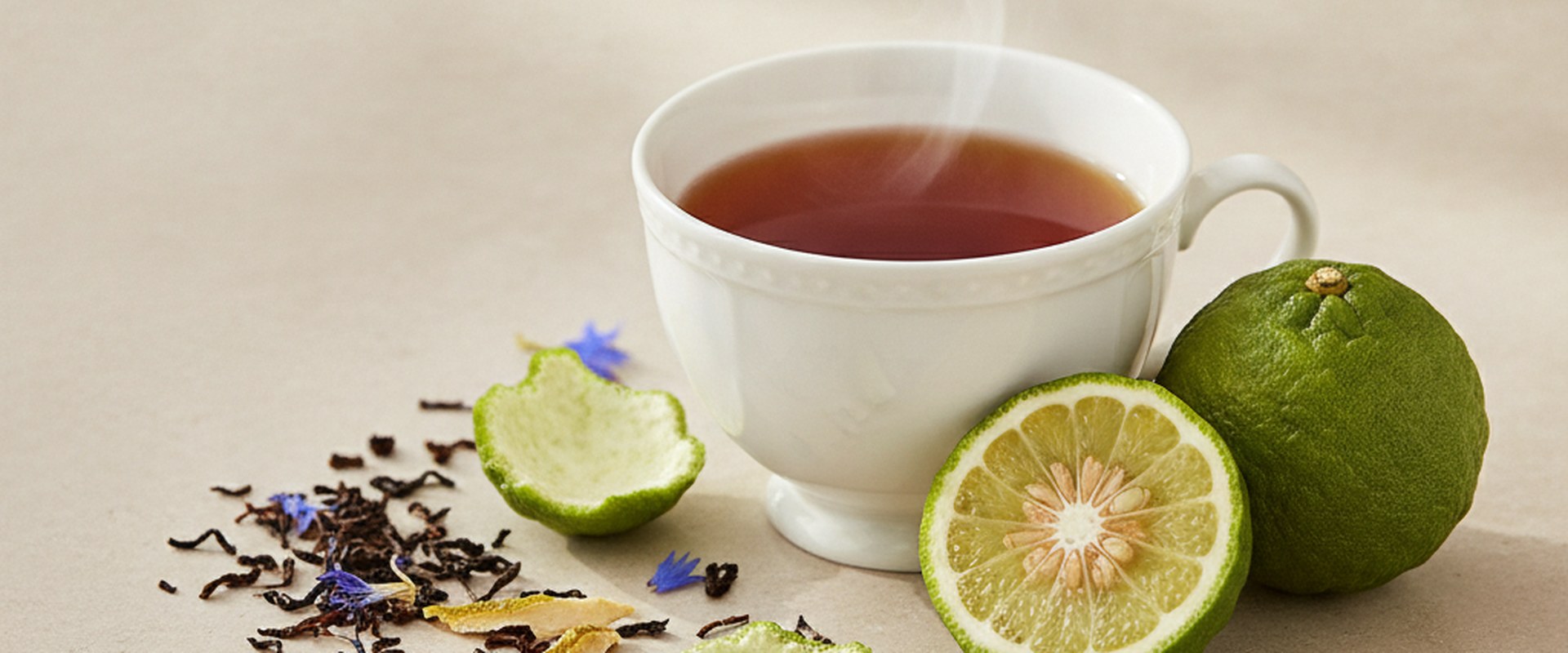
Earl Grey tea is black tea scented with the oil of bergamot, a citrus from Italy’s Calabria. It’s bergamot that gives the drink its recognizable perfume-citrus aroma with a light bitterness, by which Earl Grey is guessed blind. The base is ordinary black leaf — Ceylon, Chinese or Indian — while the whole character is set by the oil from the bergamot peel.
Under one name lie different teas: classic Earl Grey on a Ceylon base, mild Chinese Black Blooming, a “grey earl” with cornflower petals, versions on blue tea. They also differ in what they’re scented with — real oil or a cheap synthetic fragrance that smells of soap and fades by the second cup.
What Earl Grey tea is
Earl Grey is black tea plus bergamot oil (Citrus bergamia), and by definition nothing more. Bergamot is a citrus the size of an orange, but inedible: the flesh is too sour. Its value is in the peel: cold pressing yields an essential oil with a bright citrus-floral aroma, and it goes into the tea.
The technology is simple: ready black leaf is sprayed with bergamot oil, sometimes zest and petals are added. There isn’t much flavoring, but the aroma is strong — that’s enough. Quality rests on two things: a decent black base and natural oil instead of synthetics. In essence it’s a subtype of black tea, and its pros and cons are the same — they’re covered in the piece on the benefits and harms of black tea.
History: what Earl Grey has to do with it
The name Earl Grey translates as “Count Grey” — in honor of Charles Grey, Prime Minister of Great Britain in 1830–1834. Legend says a bergamot blend was presented to him as a gift, and the recipe stuck to the surname — there’s no documentary proof. A more prosaic version: bergamot was used to “lift” the aroma of mediocre leaf. Over time the trick became a classic, and in everyday speech the tea earned the nickname “grey earl.”
Taste and aroma: what bergamot gives
In Earl Grey bergamot is citrus plus florality: the aroma resembles lemon, bitter orange and something perfumed, with a velvety bitterness. In the dry leaf it reads at once, and in the cup it holds to the end if the oil is natural.
The tea’s own taste stays black — astringency, tannins, a dense body. Bergamot works on top, as an aroma, not as acidity: a good Earl Grey isn’t sour on the tongue, the citrus is sensed by the nose. A sharp perfume sweetness is almost always synthetic fragrance.
Types of Earl Grey tea
Earl Grey is distinguished by its black base and additives: the base sets the strength and character of the infusion, the additives — the shades of aroma. Three formats are the most common.
Classic on a Ceylon base
The most widespread option. The base is strong Ceylon leaf with bright astringency that holds bergamot well. The infusion is rich, dark amber — that very “British” Earl Grey for breakfast. It’s convenient to read about the base in the breakdown of Ceylon tea, and a ready blend is Earl Grey Ceylon.
Chinese Black Blooming Earl Grey
The base is Chinese black tea, milder than Ceylon, with honey-malt notes. Bergamot sounds more delicate, the infusion is less astringent and not so sharp without milk — a choice for those who find the classic a bit rough, for example Black Blooming Earl Grey. What distinguishes Chinese black teas is shown in the overview types of Chinese tea.
“Grey earl” with additives and blue tea
Cornflower petals, safflower or bits of zest are often added to the basic Earl Grey — a flavor accent and aesthetics. A separate branch is versions on blue tea (butterfly pea): formally it’s not Earl Grey, but a relative by scenting, with an unusual blue-violet infusion.
| Earl Grey type | Base | Bergamot aroma | Temperature, °C | Time, min |
|---|---|---|---|---|
| Classic (Ceylon) | Ceylon black | bright, dense | 90–95 | 3–4 |
| Black Blooming | Chinese black | soft, delicate | 90–95 | 3–4 |
| With cornflower/zest | Black + additives | bright, fresh | 90–95 | 3–4 |
| On blue tea (butterfly pea) | Blue (not camellia) | light, herbal | 85–90 | 4–5 |
The ranges are working ones — you adjust them by a couple of degrees and half a minute to your taste. Blue tea doesn’t need boiling water: its base isn’t tea but flower.
How Earl Grey tea is beneficial
Earl Grey’s benefit is first of all the benefit of black tea: antioxidant polyphenols (theaflavins and thearubigins), moderate caffeine and the amino acid L-theanine. Bergamot adds an aromatherapeutic effect — the citrus scent is perceived as invigorating.
- Antioxidants. Black leaf polyphenols work against oxidative stress — a noticeable dose in a 200 ml cup.
- Energy without harshness. A cup has about 40–60 mg of caffeine — less than an espresso. L-theanine smooths out the stimulation, so the tone is even, not “jittery.”
- Aroma and mood. In aromatherapy bergamot ether is considered mood-lifting — but that’s about scent and habit, not treatment.
Without exaggeration: Earl Grey is neither a medicine nor a fat burner — it’s a tasty black tea with a pleasant aroma and moderate tone.
How to brew Earl Grey properly
Earl Grey’s black base is brewed with 90–95 °C water for 3–4 minutes. Unlike green and white tea, black leaf needs almost boiling water to reveal body and tannins. 100 °C boiling water is allowed, but such an infusion doesn’t forgive over-steeping — a rough bitterness will appear.
The proportion is 3–4 g of leaf per 200–250 ml of water, a heaped teaspoon for a large cup. Then step by step:
- Warm the ware. Rinse the teapot with boiling water — cold walls steal 5–10 degrees.
- Pour with 90–95 °C water. Boiling water taken off the stove falls to this range in a minute or a minute and a half.
- Hold for 3–4 minutes. Three minutes is milder, four is stronger; longer than five and the aroma yields to bitterness.
- Remove the leaf. The leaf shouldn’t stand in the water endlessly, otherwise the second cup will turn bitter.
Earl Grey takes milk well: it softens the tannins and rounds out the taste. A slice of lemon is also appropriate, but it’s better to put it in the poured tea, not the brew. Sugar mutes the bergamot aroma — for those who like it.
What to drink Earl Grey with
Earl Grey is a classic breakfast tea. The citrus aroma is friendly with creamy and baked foods, so pairings are easy to choose:
- Baked goods. Scones, muffins, shortbread — bergamot sets off buttery pastry.
- Citrus and chocolate. Lemon tart, orange cake, dark chocolate.
- With milk. Strong Earl Grey with a drop of milk is an English classic with dense pastry.
- Dried fruit and nuts. Dried apricots, dates, almonds — calm pairings.
It pairs poorly with spicy and pungent food — bergamot and spices compete for aroma. But it makes a fragrant iced tea with ice and lemon.
How to choose a quality Earl Grey
The key watershed of quality is what the tea is scented with. Natural oil gives a live, full aroma; synthetic fragrance hits the nose with a sharp perfume note and fades quickly. What to look at:
- Composition. “Bergamot oil” or “natural bergamot flavoring” is good. Just “flavoring” without specifics is more often synthetic.
- Whole leaf, not dust. Rolled leaf holds the aroma; crumbs in the bag are the base for cheap tea.
- The aroma of the dry leaf. Clean citrus-floral is the norm. A “soapy” chemical note is a sign of synthetics.
- Persistence. Natural bergamot is heard even in the second infusion. If it vanished after the first pour, you bought fragrance.
A test at home: pour a pinch of leaf with warm water for a couple of minutes — natural oil opens gently, synthetic gives an intrusive “perfume” smell. It’s convenient to pick a variety in the the black tea catalogue.
Contraindications and caution
Earl Grey is a caffeinated tea, so the caution is the same as with ordinary black. A cup has 40–60 mg of caffeine, and a strong evening brew can spoil sleep. Pregnant and breastfeeding women and people with hypertension should keep it moderate — because of the caffeine, not the bergamot.
- Caffeine. Don’t drink strong Earl Grey at night or on an empty stomach — an astringent infusion on an empty stomach can feel heavy.
- Bergamot and medicines. Bergamot contains furanocoumarins — like grapefruit, they theoretically affect the absorption of some drugs. There’s little of them in a cup, but with constant medication the question is better addressed to a doctor.
- Large volumes. Isolated cases are described where several liters a day caused muscle spasms due to bergamot. A couple of cups is safe.
For a healthy person, 2–3 cups a day threaten nothing but pleasure — it’s about moderation, not a ban.
Frequently asked questions
What is Earl Grey tea in simple words?
It’s black tea scented with bergamot oil — a citrus from Calabria. The base is ordinary black (Ceylon or Chinese), and the recognizable citrus-perfume aroma comes from bergamot.
At what temperature should you brew Earl Grey?
90–95 °C, steep 3–4 minutes, proportion 3–4 g of leaf per 200–250 ml of water. Over-steeping longer than five minutes gives bitterness and mutes the bergamot.
Is Earl Grey black or green tea?
Almost always black: classic Earl Grey is black leaf with bergamot oil. Green versions are less common, and blends on blue tea (butterfly pea) are formally not Earl Grey.
How much caffeine is in Earl Grey tea?
About 40–60 mg per 200 ml cup — less than an espresso, but enough to invigorate. L-theanine in the black leaf softens the effect of caffeine, so the tone comes out even.
Can you drink Earl Grey with milk?
Yes, it’s the classic British format. Milk softens the tannins, while the bergamot aroma is preserved. Lemon is appropriate too, but it’s better added to the poured tea, not the brew.
How can you tell a natural Earl Grey from a synthetic one?
The natural one has whole leaf and a clean citrus aroma that holds even in the second infusion. The synthetic one has crumbs, a sharp “soapy” smell that vanishes after the first pour. In the composition “bergamot oil” is better than “flavoring.”
Who shouldn’t drink Earl Grey?
Caution is needed because of caffeine: pregnant, breastfeeding, with hypertension and insomnia — in moderation and not at night. Bergamot contains furanocoumarins, so with constant medication the question is worth discussing with a doctor.
The key points in brief
Earl Grey is black tea with bergamot oil, and its entire character rests on a decent base and natural scenting. Choose whole leaf, brew with 90–95 °C water for 3–4 minutes, drink it with milk or lemon — and keep it moderate because of the caffeine. You can pick a classic Ceylon or mild Chinese Earl Grey with delivery across Tashkent and Uzbekistan in the Amir Tea catalog.