



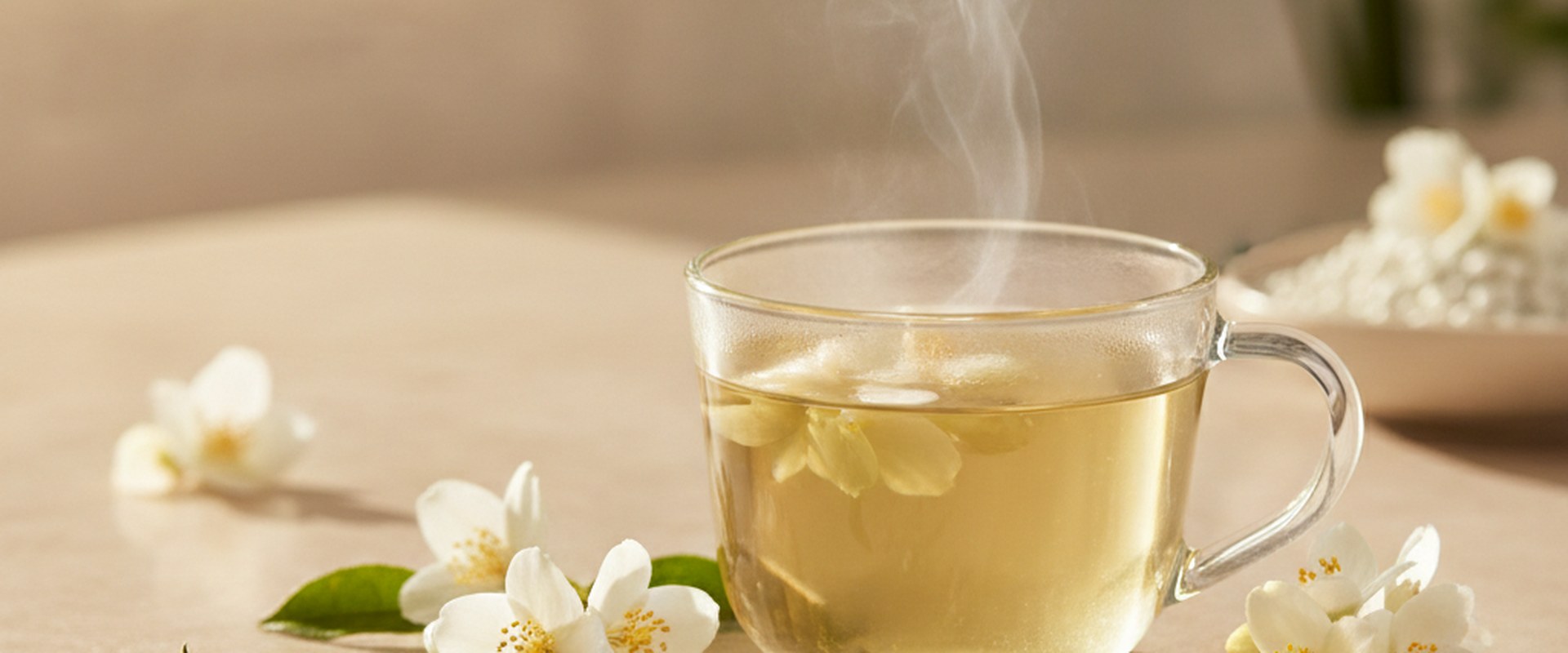
Jasmine tea is green (less often white or oolong) tea scented with live jasmine flowers. The classic is made by a multi-layer method: fresh tea leaf and buds that open toward night are laid in layers, the tea absorbs the aroma, the petals are removed and the process is repeated. In a good variety the jasmine is present in the dry leaf, in the aroma of the empty warmed ware and in the infusion itself — not only in the first sip.
There’s more confusion here than it seems. Under one name they sell both hand-rolled whole-leaf pearls and tea dust sprayed with flavoring. Their infusions differ in taste, strength and the number of re-brews. Below, to the point: what jasmine tea is made of, how it’s beneficial, at what temperature to brew it, what to drink it with and how to tell natural from fake.
The base is almost always green, so the rules are the same: no boiling water, short steeping, several infusions. If you’re still on formal terms with green leaf, this breakdown will help how to brew green tea — jasmine works by the very same logic.
What jasmine tea really is
At the heart of jasmine tea is green tea scented with the flowers of large-flowered jasmine (Jasminum sambac). The petals themselves give almost no taste — they impart aroma, while the tea leaf holds the flavor base. That’s why the quality of jasmine tea is 70% determined by the quality of the green base and only 30% by the scenting technique.
The home of this method is China’s Fujian province. The tea is harvested in spring, and scented in August when jasmine is at its peak. The buds are picked closed during the day, and they open at night — that’s when the maximum aroma comes and the tea “takes” the jasmine. One cycle is one night; premium varieties go through 5 to 9 cycles.
Formally, jasmine tea is classed among scented green teas. If you want a broader look at the category, take a look at the overview types of green tea, jasmine occupies a separate niche in it.
Varieties: from Dragon Pearl to simple loose leaf
There are dozens of jasmine tea varieties, but on the shelf you’ll meet three or four formats. They differ in the leaf roll, the base and the number of scenting cycles.
Jasmine Dragon Pearl
The top of the line. Young buds and top leaf are hand-rolled into dense 5–8 mm balls — “pearls.” Each holds 1–2 buds. When brewed, the ball slowly unfurls, giving an infusion over 3–4 pours. The aroma is soft, without sharp sweetness. This is the case where paying more for hand labor is justified by taste — worth trying with Jasmine Dragon Pearl.
Loose jasmine (Jasmine Green)
The base is ordinary green leaf not rolled into pearls. It’s 2–3 times cheaper than pearls, brews faster and holds 2–3 infusions. A good everyday option — moderately fragrant and predictable. The basic Jasmine green tea is exactly from this category.
Tied and white bases
Less often you’ll find jasmine on a white base (Bai Hao, milder and pricier) and “tied” teas — where the leaf is hand-sewn into a flower that blooms in the glass.
Natural scenting versus synthetic
The key watershed of quality is how the aroma got into the tea. There are three methods, and the price of their infusions differs several times over.
- With live petals (the right way). The tea is repeatedly layered with fresh buds. The aroma is full, alive, changing slightly from pour to pour. In the dry leaf you often see 1–2 dried white petals — a mark of the technology, not “litter.”
- With jasmine essential oil (a compromise). Natural oil, but the aroma is flatter and more even than from a live flower. Acceptable for everyday tea.
- With synthetic flavoring (steer clear). A sharp perfume smell that hits the nose from the dry leaf and quickly fades in the cup. After the second infusion the aroma almost disappears.
A simple test at home: pour a pinch of leaf with cold water for 3–4 minutes. Natural jasmine opens gently, while synthetic gives an intrusive “soapy” smell.
How jasmine tea is beneficial
The benefit of jasmine tea is first of all the benefit of the green base: antioxidant catechins (including EGCG), polyphenols and moderate caffeine. Jasmine adds an aromatherapeutic effect — the scent of linalool reduces subjective tension.
- Antioxidants. Green tea catechins work against oxidative stress. A cup (200 ml) holds a noticeable dose of polyphenols, comparable to ordinary green leaf.
- Gentle tone. Jasmine tea has about 25–35 mg of caffeine per cup — half as much as an espresso. Plus the amino acid L-theanine smooths out the stimulation: energy without jitteriness.
- Aroma and relaxation. The smell of jasmine is used in aromatherapy as relaxing — a cup in the evening works as a wind-down ritual, if you don’t overdo the strength.
There’s a flip side too: caffeine disrupts sleep, and on an empty stomach a strong infusion can feel heavy. The pros and cons are covered in detail in our piece on the benefits and harm of green tea — for jasmine they’re the same.
How to brew jasmine tea properly
The main rule: no boiling water. The green base “overcooks” at 100 °C, turns bitter and loses the jasmine aroma. The working range is 75–85 °C. For delicate pearls closer to 75–80 °C, for dense loose leaf and a white base — 80–85 °C.
The proportion is 3–4 g of leaf per 150–200 ml of water: a teaspoon of pearls or a spoon and a half of loose leaf. Then choose one of two approaches.
- European (a single steep). You brew it, hold for 2–3 minutes, pour it all out. Simple, but it opens the leaf only halfway.
- By infusions (Chinese style). You pour over the same leaf briefly — the first infusion 20–40 seconds, each next one 10–15 seconds longer. Pearls give 3–4 infusions this way, with the aroma unfolding layer by layer.
The water is brought to the first bubbles and cooled: boiling water taken off the stove falls to about 80 °C in 4–5 minutes. Warm the ware in advance — a cold teapot steals 5–10 degrees.
| Base | Temperature, °C | 1st infusion | Number of infusions | Leaf per 150 ml |
|---|---|---|---|---|
| Pearls (Dragon Pearl) | 75–80 | 25–40 sec | 3–4 | 3 g |
| Loose green | 80–85 | 2–3 min* | 2–3 | 3–4 g |
| White base | 80–85 | 3–4 min* | 2–3 | 4 g |
| Tied (flower) | 80–85 | 3–5 min | 2 | 1 bud |
* for loose and white a European steep is given; with the infusion method the first steep is shortened to 30–40 seconds.
What to drink and pair it with
Jasmine tea is self-sufficient, but pairings don’t spoil it. Sugar is almost always superfluous — it drowns out the jasmine. Neutral and light pairings work better.
- Eastern sweets. Baklava, dried apricots, dates, halva — the sugary note of the dessert sets off the floral aroma.
- Fresh fruit. Pear, peach, grapes — they don’t argue with jasmine but support it.
- Light food. Rice, seafood, vegetables, young cheese. Jasmine tea is a classic companion to Asian cuisine.
- No milk. Milk kills jasmine completely — this isn’t a tea to drink with milk.
Add honey or mint to the already poured tea, not to the brew. A slice of lemon is allowed, but it overrides the aroma more than you’d want.
How to choose quality jasmine tea
The price of natural jasmine tea starts noticeably above the cheapest shelf — a live flower and hand work cost money. What to look at when buying:
- Whole leaf, not dust. Large rolled leaf or even 5–8 mm pearls are good. Crumbs and fragments in the bag are the base for a “dusty” flavored tea.
- The aroma of the dry leaf. Clean, floral, not sharp. A perfume-like “chemical” note is a sign of synthetics.
- Single petals. 1–3 dried petals per portion is the norm for tea with a live flower. A handful of petals “for looks” is more often masking a weak base.
- Re-infusions. Good jasmine gives 3–4 infusions. If the taste vanishes after the second pour, you bought flavored fines.
Jasmine tea is a subtype of Chinese green tea, and their selection logic is shared. It’s convenient to pick ready varieties to your taste straight from the green tea catalog.
How to store it so it doesn’t lose aroma
Jasmine is a volatile aroma — it leaves first: an open pack on the shelf loses its smell in 3–4 weeks. To keep the tea for 8–12 months, follow four conditions:
- Airtightness. An opaque jar with a tight lid or a zip bag with the air pressed out. Oxygen oxidizes the catechins and blows away the aroma.
- Darkness. Light destroys green leaf. Clear glass jars only in a closed cupboard.
- No smells nearby. Tea draws in the smell of spices, coffee and household chemicals — keep it separately.
- Room temperature. The fridge is harmful: condensation when you take it out ruins the leaf.
Frequently asked questions
At what temperature should you brew jasmine tea?
75–85 °C. For Dragon Pearl pearls — 75–80 °C, for loose green and a white base — 80–85 °C. Boiling water (100 °C) turns it bitter and kills the jasmine aroma.
How many times can you brew jasmine pearls?
Quality Jasmine Dragon Pearl holds 3–4 infusions. The first is 25–40 seconds, each next one 10–15 seconds longer. Loose jasmine gives 2–3 infusions.
Is jasmine tea green or black?
Almost always green: the base is green leaf scented with jasmine flowers. Less often you’ll find a white-tea or oolong base. Black jasmine tea is practically never made.
How much caffeine is in jasmine tea?
About 25–35 mg per 200 ml cup — half as much as an espresso. Plus L-theanine softens the effect of caffeine: the energy comes out smooth, without jitteriness.
How can you tell natural jasmine tea from a flavored one?
The natural one has whole leaf, a soft floral aroma, 1–3 dried petals and holds 3–4 infusions. The synthetic one has crumbs, a sharp perfume smell, and the aroma vanishes after the second pour.
Can you drink jasmine tea at night?
The smell of jasmine relaxes, but the caffeine in the base invigorates. Two or three hours before sleep it’s better to brew it weak: a short 20–30 second steep and less leaf. Those sensitive to caffeine should be cautious in the evening.
What shouldn’t you drink jasmine tea with?
With milk — it kills the jasmine completely. Sugar also overrides the aroma. The best pairings are Eastern sweets, dried fruit, fresh fruit and light Asian food without strong spices.
The key points in brief
Jasmine tea is a green base plus the aroma of live jasmine, and it’s valued precisely for the balance of light tone and a relaxing scent. Choose whole leaf, brew with 75–85 °C water, don’t skimp on 3–4 infusions and store it airtight in the dark — then the cup will give everything this tea is loved for. You can pick a variety with delivery across Tashkent and Uzbekistan in the Amir Tea catalog.